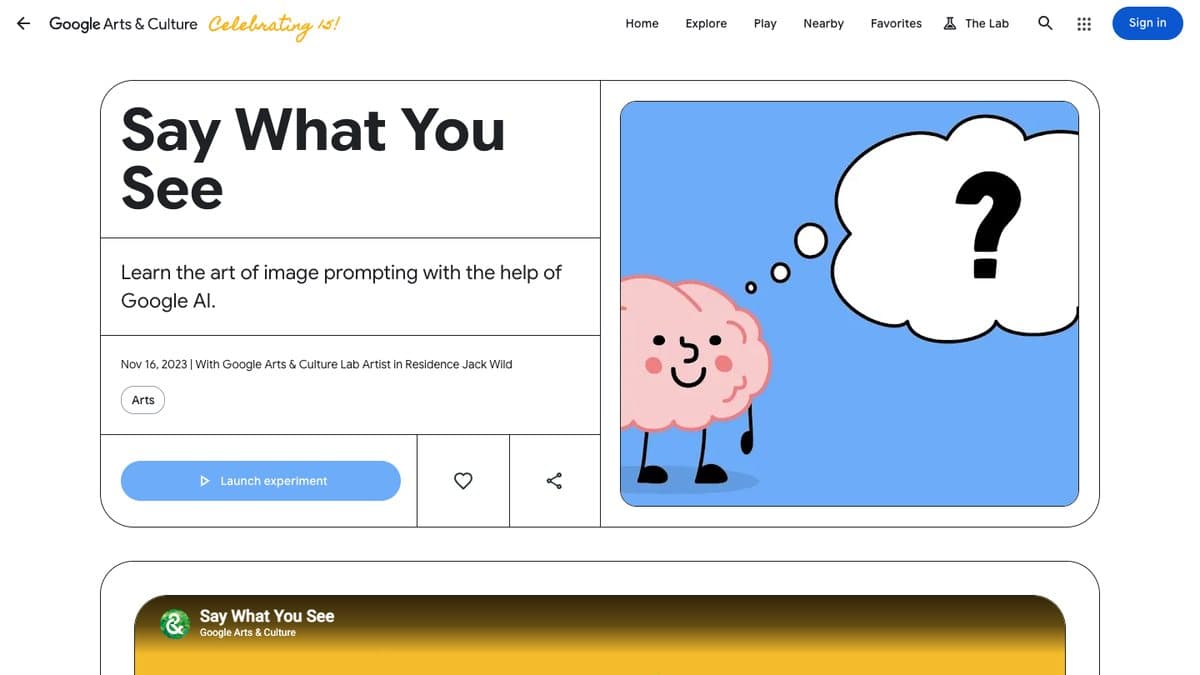
What is Say What You See?
Say What You See is a game from Google Arts & Culture, created by Jack Wild while he was artist in residence at the Google Arts & Culture Lab. It was released in November 2023 and 9to5Google covered it as a game that teaches you how to write image prompts.
On one side you see an image made by Google AI. Your job is to describe it in up to 120 characters. Google AI then generates a new image from your words, and the game scores how closely it matches. Level 1 needs a 50 percent match, Level 2 needs 60 percent, and so on, with three attempts per image and tips along the way. It is a neat way to train your eye for detail and learn what makes a good prompt.
What You Can Do
- Describe AI-generated images in 120 characters or less
- See your own prompt turned into a new image
- Get a match score against the original
- Move through levels that need closer and closer matches
- Pick up tips for writing better prompts
How to Play Say What You See
- Open Say What You See on Google Arts & Culture.
- Study the image shown on screen.
- Type a description of up to 120 characters and submit it.
- Check your score and try again until you pass the level.
Is Say What You See Free?
Say What You See is a free Google Arts & Culture experiment with no payment needed. You can play in the browser or the Google Arts & Culture app.
Who Will Enjoy It?
- Beginners who want to learn image prompting
- Teachers introducing AI image tools
- Art lovers who like describing pictures
- Anyone who enjoys a gentle, level-based challenge
Websites Like Say What You See
- Odd One Out: Another Google game where you spot the AI image.
- Poem Postcards: Google AI writes a poem about a famous artwork for you.
- Which Face Is Real?: Test how well you can spot AI-generated faces.
Frequently Asked Questions
Is Say What You See free?
Yes. It is a free experiment on Google Arts & Culture.
How long can my prompt be?
Up to 120 characters.
How do I pass a level?
Your image has to match the original closely enough. Level 1 needs 50 percent and each level asks for more, with three tries per image.