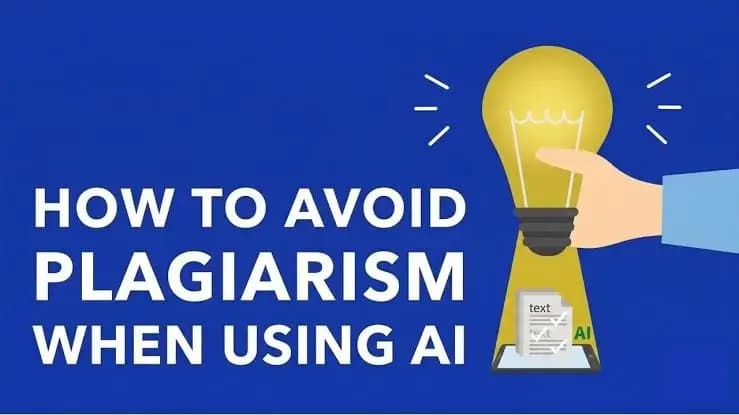
\I've been using AI almost every day for writing articles, YouTube scripts, and business content. One thing I've learned is that AI itself isn't plagiarism - but how you use it can become plagiarism.
Understanding the difference can save you from academic penalties, copyright issues, and damaged credibility.
Let's break it down.
What Is Plagiarism?
Plagiarism means presenting someone else's work, words, or ideas as your own without proper acknowledgment.
Traditionally, plagiarism included:
- Copying paragraphs from websites
- Rewriting someone else's article with only minor wording changes
- Submitting another person's work
- Using copyrighted material without permission
The key issue isn't whether AI helped you write.
The issue is whether the final content improperly copies existing work or falsely claims originality.
Is AI-Generated Content Automatically Plagiarism?
No.
Most modern AI models generate new text by predicting the next word based on patterns learned during training.
They don't normally copy entire articles word-for-word.
However, AI can still create plagiarism risks when users:
- Copy AI output without checking it
- Ask AI to imitate a specific author's writing
- Generate summaries that closely resemble the original wording
- Publish AI-generated content without fact-checking or editing
Think of AI as a writing assistant - not a replacement for your own judgment.
When AI Can Become Plagiarism
Here are some common situations where problems arise.
1. Copying AI Output Without Reviewing It
Some AI responses may unintentionally resemble existing online content.
If you publish everything exactly as generated, you risk accidental duplication.
Always review and rewrite important sections.
2. Asking AI to Copy a Specific Author
For example:
"Write exactly like Stephen King."
or
"Rewrite this article so nobody notices."
These prompts cross ethical lines and may produce content that is too close to the original.
Instead, ask AI for characteristics:
- conversational
- professional
- humorous
- persuasive
- academic
rather than copying an identifiable writer.
3. Using AI to Rewrite Existing Articles
Many people paste entire blog posts into AI and ask:
"Rewrite this."
The result is often just superficial paraphrasing.
If the ideas, structure, and wording remain substantially similar, plagiarism checkers may still flag it.
4. Forgetting to Cite Sources
AI often summarizes information from general knowledge.
If you're discussing:
- research papers
- statistics
- medical information
- legal advice
- scientific discoveries
always verify the information and cite the original source.
What About Schools and Universities?
Many educational institutions now allow limited AI use - but they expect transparency.
For example:
Acceptable:
- brainstorming ideas
- grammar improvement
- outlining essays
- explaining difficult concepts
Unacceptable:
- submitting AI-generated assignments as entirely your own
- fabricating references
- generating complete research papers without disclosure (where prohibited)
Always check your institution's AI policy.
Can AI Content Be Detected?
Sometimes but not reliably.
AI detectors attempt to estimate whether text was written by AI, but they frequently produce false positives and false negatives.
Even major AI companies acknowledge that no detector is perfectly accurate.
Instead of worrying about "beating AI detectors," focus on producing original, well-researched writing that reflects your own thinking.
How to Use AI Without Plagiarizing
Here are the habits I follow whenever I write with AI.
Start With Your Own Ideas
I usually begin by writing:
- my outline
- personal experience
- examples
- opinions
Then I ask AI to improve organization or wording.
This keeps the article authentic.
Add Personal Experience
AI cannot replace your real experiences.
For example:
Instead of saying:
AI saves time.
Write:
After testing more than 30 AI writing tools over the past year, I've found that AI dramatically speeds up first drafts, but I still spend significant time verifying facts and rewriting sections to match my own style.
Original experiences make your content unique.
Verify Facts
AI occasionally invents:
- statistics
- quotations
- references
- URLs
Always double-check important claims before publishing.
Rewrite in Your Own Voice
Don't simply copy AI output.
Read each paragraph and ask:
- Would I naturally say this?
- Does it sound like me?
- Can I explain this better?
Your own voice is something AI cannot fully replicate.
Best Tools to Avoid Plagiarism
Using plagiarism checkers before publishing is one of the easiest ways to catch accidental similarities.
1. Grammarly Plagiarism Checker
Best for:
- students
- professionals
- business writing
Features:
- plagiarism detection
- grammar correction
- writing suggestions
Ideal if you already use Grammarly for editing.
2. Turnitin
Best for:
- universities
- academic institutions
Features:
- compares against academic databases
- detects copied text
- widely used in education
Many schools already use Turnitin for assignment submissions.
3. Copyscape
Best for:
- bloggers
- website owners
- SEO professionals
Features:
- finds duplicate web content
- detects copied articles online
Excellent for checking published blog posts.
4. Quetext

Best for:
- freelance writers
- content creators
Features:
- DeepSearch plagiarism detection
- citation assistance
- easy-to-read reports
A good balance between affordability and accuracy.
5. Originality.ai
One of my favorite tools for AI-assisted content.
Best for:
- publishers
- agencies
- SEO teams
Features:
- plagiarism detection
- AI-generated content detection
- readability analysis
- team collaboration
If you publish AI-assisted articles regularly, Originality.ai is worth considering.
6. Scribbr Plagiarism Checker
Best for:
- theses
- dissertations
- academic writing
Features:
- extensive academic database
- citation guidance
- detailed similarity reports
Especially useful for students working on major research projects.
7. Copyleaks
Best for:
- businesses
- educators
- enterprises
Features:
- plagiarism detection
- AI content detection
- source comparison
- API integration
Popular among organizations that review large volumes of content.
A Simple AI Writing Workflow That Avoids Plagiarism
Here's the process I personally follow:
- Research the topic from reliable sources.
- Create my own outline.
- Add my own opinions and experiences.
- Use AI to expand sections and improve clarity.
- Fact-check every important claim.
- Rewrite sections to match my writing style.
- Run a plagiarism check using Originality.ai, Grammarly, or Copyscape.
- Perform a final proofread before publishing.
This workflow is faster than writing everything manually while still producing original content.
Final Thoughts
Using AI is not plagiarism.
Copying without thinking is.
AI works best when it's treated as a creative assistant rather than an automatic author. The more you contribute your own insights, examples, and expertise, the more valuable and original - your writing becomes.
Before hitting Publish, take a few extra minutes to edit, verify facts, and run a plagiarism check. Those simple steps can help ensure your content is both trustworthy and uniquely yours.