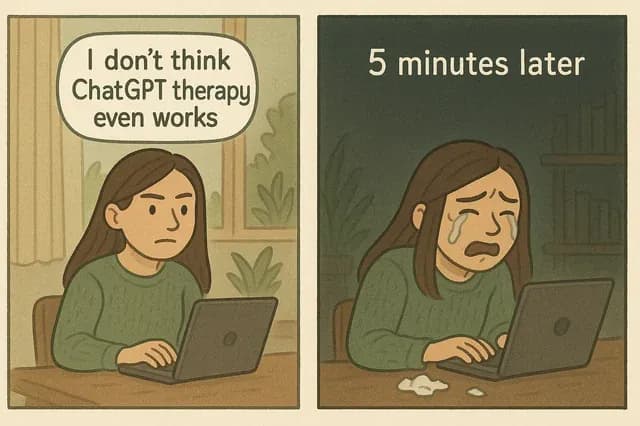
My Own Experience with AI Conversations
As someone who uses AI regularly, I've noticed something interesting.
AI conversations often feel smoother than human conversations.
There are no awkward pauses. No misunderstandings. No fear of saying the wrong thing.
If I need advice at midnight, AI responds immediately.
But that's also where the problem begins.
The most meaningful conversations I've had in my life were rarely the easiest ones. They involved disagreement, vulnerability, and sometimes discomfort.
My closest friendships were built through shared experiences, difficult discussions, and mutual support during challenging times.
An AI can simulate empathy remarkably well, but it cannot genuinely experience life alongside me.
That's an important distinction.
Why AI Relationships Feel So Attractive
Human relationships are complicated.
People forget birthdays. Friends cancel plans. Partners misunderstand each other.
AI companions remove much of that friction.
For someone experiencing loneliness, grief, anxiety, or social isolation, an AI companion can provide immediate comfort. Recent stories have documented users developing deep emotional bonds with AI systems, sometimes describing them as their closest confidants.
The attraction makes sense.
After all, everyone wants to feel heard.
The concern is not that people are talking to AI.
The concern is whether AI begins replacing human relationships instead of supporting them.
What the Research Is Starting to Show
Researchers are only beginning to understand the long-term effects of AI companionship.
A 2025 study involving over 1,100 AI companion users found that people with smaller social networks were more likely to seek companionship from chatbots. The researchers also found that intensive companionship - oriented chatbot use was associated with lower well-being, particularly among users with limited human social support.
Another large study involving nearly 1,000 participants found that heavier chatbot use was associated with greater loneliness, emotional dependence, and reduced socialization with real people.
These findings don't prove that AI causes loneliness.
However, they suggest that AI may not be able to fully satisfy the social needs that human relationships provide.
In other words, AI can be a comforting companion, but it may not be a complete substitute for human connection.
The Real Danger Isn't AI

I don't think the greatest danger is that people will fall in love with robots.
The greater danger is that we may start expecting humans to behave like robots.
Real people are imperfect.
They disagree with us.
They challenge us.
They don't always respond instantly.
Yet those imperfections are often what make relationships meaningful.
A friendship that survives conflict becomes stronger.
A difficult conversation can deepen trust.
A supportive hug communicates something no algorithm can fully replicate.
The goal shouldn't be to eliminate friction from relationships.
The goal should be to navigate it.
Practical Ways to Stay Connected in the AI Age

As AI becomes more integrated into everyday life, I believe we need intentional habits that keep human connection at the center.
1. Use AI as a Tool, Not a Replacement
AI can help organize thoughts, prepare for conversations, and provide information.
But important relationships still need real people.
2. Schedule Human Connection
Friendships often fade because we assume they'll maintain themselves.
Call someone. Meet for coffee. Send the message first.
3. Create Shared Experiences
Research consistently shows that belonging grows through repeated interaction.
Join a club, volunteer, take a class, or participate in local events.
4. Accept Relationship Friction
Not every conversation needs to be perfect.
The awkwardness, disagreement, and unpredictability of human interaction are often what make relationships authentic.
5. Spend More Time Offline
Technology is wonderful for communication, but some forms of connection still work best face-to-face.
A walk, a meal, or a shared activity often creates stronger bonds than hours of messaging.
Final Thoughts
AI companions are not simply a technology story.
They are a mirror reflecting a deeper reality about modern life.
People aren't turning to AI because they prefer machines.
They're turning to AI because many are struggling to find the connection they need from other humans.
The WHO's finding that one in six people worldwide experiences loneliness should concern all of us.
AI may help alleviate some of that loneliness.
But the long-term solution is unlikely to be found in smarter chatbots.
It will be found in stronger communities, deeper friendships, healthier relationships, and a renewed commitment to being present for one another.
The future isn't about choosing between humans and AI.
It's about making sure that, as AI becomes more human-like, humans don't become less connected to each other.