What is Play a Kandinsky?
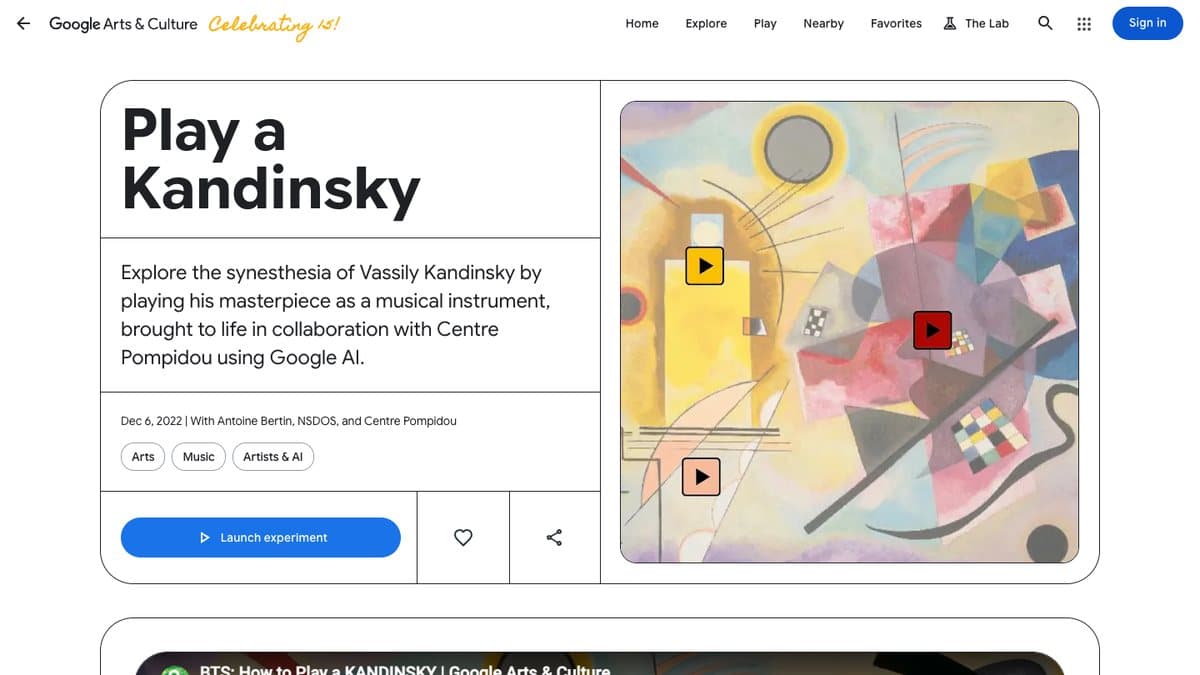
Play a Kandinsky is a Google Arts & Culture experiment made with the Centre Pompidou in Paris. The painter Vassily Kandinsky wrote about seeing colours as sounds, a condition known as synaesthesia. This experiment takes his 1925 painting Yellow-Red-Blue and lets you hear what he might have heard while painting it.
Sound artists Antoine Bertin and NSDOS worked with Google Magenta's Transformer model, trained on music from Kandinsky's era, and drew on his writing about which sounds and feelings he linked to each colour and shape. You first walk through his ideas, then click parts of the painting to trigger musical phrases and build your own mix. Engadget, Hyperallergic and The Next Web covered it when it launched in 2021.
What You Can Do
- Click shapes and colours in Yellow-Red-Blue to hear them
- Learn about Kandinsky's synaesthesia and theory of colour
- Explore the emotions he linked to each colour and shape
- Hear a composed version of the whole painting
- Create and play your own musical mix
How to Play Play a Kandinsky
- Open Play a Kandinsky on Google Arts & Culture and turn your sound on.
- Follow the short introduction to Kandinsky's ideas.
- Click areas of the painting to trigger sounds.
- Layer sounds to build your own composition.
Is Play a Kandinsky Free?
Play a Kandinsky is a free Google Arts & Culture experiment with no account or payment needed.
Who Will Enjoy It?
- Art lovers curious about Kandinsky
- Musicians who like experimental sound
- Teachers covering art history or the senses
- Anyone who wants a calm, creative few minutes
Websites Like Play a Kandinsky
- Chrome Music Lab: Includes its own Kandinsky toy plus other playful music experiments.
- Paint With Music: Machine learning turns your brushstrokes into music.
- Blob Opera: Another Google Arts & Culture music experiment powered by machine learning.
Frequently Asked Questions
Is Play a Kandinsky free?
Yes. It is a free experiment on Google Arts & Culture.
Which painting does it use?
Kandinsky's 1925 painting Yellow-Red-Blue, held by the Centre Pompidou.
How does the AI part work?
The sounds were created with Google Magenta's Transformer model, trained on music from Kandinsky's time and guided by his writing on colour and sound.