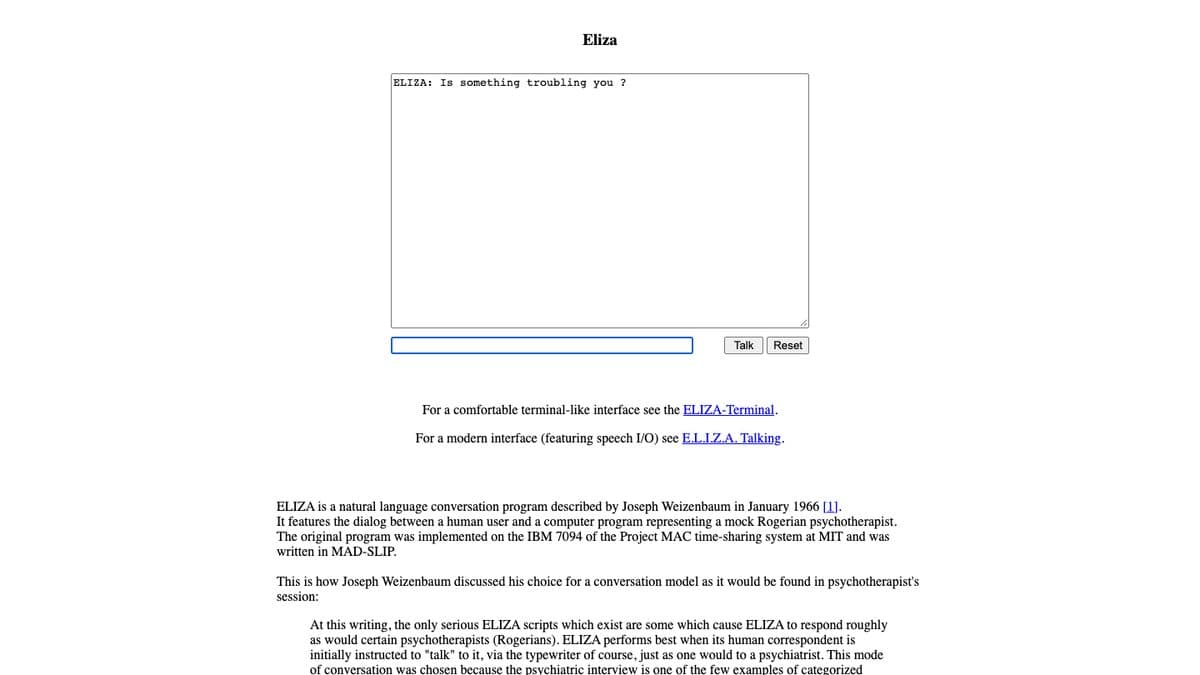
What is ELIZA?
ELIZA was created by Joseph Weizenbaum at MIT in the 1960s and is one of the first chatbots ever made. Its best-known script plays a Rogerian psychotherapist: it picks up key words in what you type and turns them back into questions, so you say you feel tired and it asks why you feel tired. This version is elizabot.js, a JavaScript recreation by Norbert Landsteiner of mass:werk, written in 2005.
Talking to it is a fun lesson in how little it takes to feel understood. ELIZA has no knowledge or memory, only pattern rules, yet it can be surprisingly convincing. That came back into the news in 2023, when a UC San Diego Turing test study by Cameron Jones and Benjamin Bergen found ELIZA was judged human 27 percent of the time, ahead of GPT-3.5 at 14 percent.
What You Can Do
- Chat with a recreation of the original 1966 ELIZA
- See the classic therapist script in action
- Compare its rule-based replies with modern AI chatbots
- Read background on Weizenbaum's original program
- Use it free in any browser
How to Play ELIZA
- Open masswerk.at/elizabot.
- Type how you feel or what is on your mind.
- Read ELIZA's reply and keep the conversation going.
- Try to catch it out and spot the patterns it uses.
Is ELIZA Free?
This ELIZA is completely free with no login or ads. The elizabot.js code is distributed as free software.
Who Will Enjoy It?
- Anyone curious about the history of AI
- Students learning how chatbots work
- People who want to compare old and new chatbots
- Retro computing fans
Websites Like ELIZA
- Turing Test Live: Try to tell a human from an AI in a live chat.
- Goody-2: A modern chatbot joke that refuses almost everything.
- HackMerlin: Chat your way past an AI wizard guarding a secret word.
Frequently Asked Questions
Is ELIZA free?
Yes. This online version is free with no login and no ads.
Is this the original ELIZA?
It is a faithful JavaScript recreation by Norbert Landsteiner of Joseph Weizenbaum's 1960s program and its therapist script.
Did ELIZA really beat ChatGPT?
In a 2023 UC San Diego Turing test study, ELIZA was judged human 27 percent of the time, ahead of GPT-3.5 at 14 percent. GPT-4 scored higher than both.